

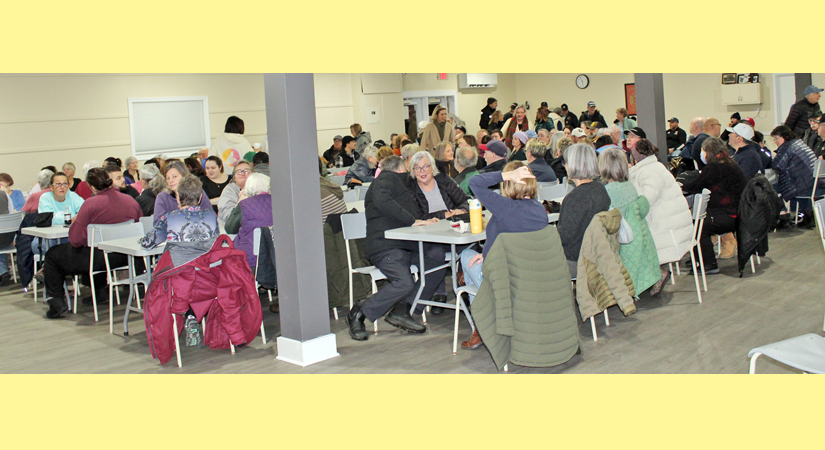
The Inverness Volunteer Fire Department Hall was full of concerned citizens who wanted to discuss how to manage the growing drug problem in the community.
January 21, 2026
-by Beverley Phillips
An estimated 300 people filled the Inverness Volunteer Fire Department hall last Wednesday night to discuss how to tackle the growing drug problem in the community.
Dwayne Beaton and Blaine Cathcart organized and chaired the meeting. Both have personal experience with addictions. Beaton is 10 years sober, and Cathcart has been in recovery for eight years.
Cathcart read a story about a man he called Bill that encapsulated why this meeting was necessary. Bill had a drug problem and became suicidal. After a few days in the hospital, Bill was deemed no longer at risk, but had nowhere to go. He left the hospital and was soon back to how he started, and a desperate family took him to another province for care. “Where is humanity in all of this?” Cathcart read. “One decision on this side of healthcare, or lack thereof, can be the deciding factor on who is living and dying outside. People are dying from this disinterest. My friend hasn't slept since he came out of his self-induced coma. He's been dismissed and rejected from a barely beating system. He is loved dearly and is fortunate that he has a family that can drop their own lives and whisk him halfway across this country in a desperate effort to help him.”
Cathcart concluded by sharing a bit of his own story on rebuilding his life after an addiction. “There is hope, and I’m proof of it,” he said.
Beaton said it was the overnight detox program at Strait Richmond that saved his life, but that program has since been cut.
Invited speakers from healthcare, the RCMP, and local elected officials, MLA Kyle MacQuarrie and MP Jaime Battiste, all offered their support and shared what they had to offer.
Battiste said he can identify with what the community is going through. He was an advisor to the chief in Eskasoni 16 years ago when there was a suicide crisis. They set up a crisis centre that was only supposed to be there for 72 hours, but has been open ever since. Battiste said he’s ready to help and work with MLA MacQuarrie any way he can. He also suggested that if they want advice in establishing a crisis centre, they should call Eskasoni, which would be more than willing to help.
The heart of the meaning came when the mic was opened to the floor. The full house heard from both recovered addicts and family members of addicts. They spoke about the gaps in the care they experienced. They noted how they or their loved ones have been in and out of care, and how, even if they could get access to detox, they still needed access to rehab afterwards, but didn’t get it. One speaker compared the situation to a leg injury. “There’s rehab after a leg injury; those with addictions need rehab for their minds,” she said.
While Nadine Wadden, director of mental health and addictions, had spoken about the outpatient care that is available, those who have needed help said it has not been meeting their needs.
“It’s easy to stand here and say there’s help, but the province does not have what we need right now,” said one speaker who spoke of her daughter who needed help.
According to another meeting attendee, part of the journey following detox should be a program like AA. “People can go to programs,” he said, “but you can’t live in detox; you have to leave.” Thirty-seven years ago, he started going to AA, and he still goes to meetings four times a week. “The only way I stay sober is by talking to other addicts,” he said. “It still works, and I still take it one day at a time. You can’t stay sober without meetings.”
But not everyone becomes an addict, though they use drugs on occasion. One mother spoke about her son, a young man with a promising future, who died at the age of 19 from drugs. “We need to look for harm reduction strategies,” she said. “These drugs are here and aren’t going anywhere. We need better ways to do things because what we’re doing isn’t adequate.”
On everyone’s mind was what the solutions were. There were offers of volunteering time to help the situation, and others who said that drug dealers should be going to jail.
Doug Hill brought up the risk factors of addiction, including personality, family history, and poverty. Those issues need to be addressed, and he suggested we should look at what we can do in the community. Action could include, he suggested, forming support groups for teens and families, and looking at how we can reduce barriers and get youth more involved in music, the trades, fitness centres, and therapeutic approaches, like horse therapy.
Following the meeting. Beaton said the turnout was overwhelming, and he was glad that people kept positive. “What we do next is important,” he said. He plans to continue to lobby the government to reopen the detox centre in Strait Richmond, and thought getting a facility in the area was a great idea. He also noted, “It’s important that we do not criminalize the disease, but help the addicts, if we can.”
Cathcart was also feeling positive about how the evening went. “I am super encouraged by the turnout and the temperature of the meeting. We now have community agencies that have stepped up and recognized the issue. Police, elected officials, nurses, doctors, pharmacists, and community members. The next logical step to me is to form a committee to hold all these people accountable going forward. I hope that Dwayne and I get the opportunity to sit down with mental health and addiction in a closed meeting sooner rather than later. It was a great starting point; now we need to hold feet to the fire.”
Inverness County Warden Bonny MacIsaac said in a statement, “I was pleased to see so many members of the community attend and share thoughtful feedback in a respectful and constructive manner. The municipality will follow up with the local Member of Parliament, Jaime Battiste, to learn more about his suggestion for an addiction recovery centre and will support and advocate where appropriate at the municipal level.”
RCMP officer Sergeant Lance Wood said he was thrilled to see so many people come out for the meeting. “It shows the community cares,” he said. When he spoke earlier in the evening, he encouraged people to report things when they see them happening and to stay away from rumours and vigilante actions. “Even if you aren’t seeing immediate results, there are things happening behind the scenes,” he said. He also mentioned the RCMP isn’t just there for law enforcement, but that they could point people to resources.
Local healthcare workers spoke throughout the evening about resources available locally. Freeman’s pharmacist, Martin McKinnon, said they have programs to help that they didn’t have before, and they, too, can help point people in the right direction.
In terms of accessing medical help now, Dr Jasmine Lowry told the room that the ER is open 24 /7. “We don’t turn people away,” she said. “People are welcome, and we are here to help. It’s not ideal, but it is here. And, if you need follow-up and don’t know where to go, we will try to help.”
Mental health nurse Charlene Murphy recognized that navigating the system isn’t easy and asked people to call her office at 902-258-1911 for help, and that a doctor’s referral isn’t necessary.
To learn more about mental health and addictions services online: MHAhelpNS.ca
Recovery Support Program Strait Richmond Hospital: 902-625-3230
Mental Health and Addictions Intake Service: 1-855-922-1122
Peer support phone line: 1-800-307-1686 (for non-crisis service)
Provincial Mental Health and Addictions Crisis line: 1-888-429-8167
Kids Help Phone: 1-800-668-6868 or text to connect 686868
For a listing of local AA meetings, see the community bulletin board on page 14.